Synthos Think Pieces · the successor-system question · August 19, 2026
From Petrodollars to Compudollars
For fifty years, oil served as the underlying asset of the petrodollar system — with the rise of AI, can compute take its place? If the frame is right, it reorganizes where value accrues for a generation — which assets are strategic, which debt is safe, who the marginal buyer of Treasuries turns out to be. The idea is still fringe; examining it now costs attention rather than performance. All models are wrong, the statistician George Box said, but some are useful; the same holds for frames, and it sets this piece's bar. Not is the compute-dollar true — is it useful: what it organizes, what it predicts, what would break it. The frame escaped the fringe twice in one August week — named in a Gavekal note by Louis Gave, and operationalized on a stage where $500B of third-party capital was announced for the buildout. Tested leg by leg against what the tracked voices actually said: three petrodollar legs are present (universal input, dollar pricing, chokepoint politics). One is under construction — CME GPU futures pending CFTC approval, the first investment-grade non-recourse GPU financing already priced at SOFR+225. The load-bearing leg is inverted: oil surpluses funded Treasuries; compute capex competes with them — so far, the old system's surpluses are funding their would-be successor. And one objection oil never faced: the new commodity's own numeraire deflates 10–100x a year by its principals' stated numbers. A barrel was always a barrel. A unit of intelligence refuses to hold still.
Synthos Research · synthosresearch.com · Think Piece · quotes are verbatim transcript spans; all other claims are paraphrased from the named speaker's dated remarks in the Synthos knowledge base, window ending August 17 · educational only, not investment advice↷ What changed: August 11 — six financing platforms, $500B of third-party capital, and the balance sheets stepped aside. The recycling mechanism the analogy was missing was announced, not inferred.
The five legs, scored
- 1 · Universal input
- Presentevery economy needed the barrel; now even non-tech corporates blow through compute budgets
- 2 · Dollar pricing
- PresentGPU-hours rent in dollars, carry a forward curve, and fungibility is being manufactured by benchmark
- 3 · Surplus recycling
- Invertedoil funded Treasuries; compute borrows against them — securitization is the announced fix
- 4 · Chokepoint politics
- Presentexport controls, Taiwan, rare earths — and the state already keeps production-share statistics
- 5 · Financialization
- Buildingfrom no futures market at all (2024) to CFTC-pending CME contracts in 22 months
A frame with two authors
The idea did not originate here. Raoul Pal stated an early version on July 2, 2024: compute and energy, denominated in joules, replacing the dollar as the economic denominator — and he welded it, even then, to the dying recycling leg, as the petrodollar link weakens and Saudi Treasury buying collapses. Luke Gromen — the compute thesis's most formidable skeptic, as we will see — planted its premise himself back on May 3, 2021, observing that China runs deficits in only two things, semiconductors and oil, and calling chips the new oil. And on August 16 Louis Gave gave it its name, in a note arguing that "AI and stablecoins could reshape rather than simply destroy dollar dominance." As Jordi Visser relayed it, reading the note aloud: "Gavekal raises the provocative idea of a compute dollar replacing the petro dollar" — compute as "an industrial resource, a geopolitical asset and potentially a pillar of the monetary system." Across the hundreds of hours of transcript behind this piece, the two words — petrodollar, compute — otherwise never meet in one sentence. The splice is genuinely new, and Gave is its co-author.
The system being succeeded had a precise anatomy, and Lyn Alden has documented it as carefully as anyone (September 2021 onward): the 1974 arrangement forced global dollar demand, made the US a structural exporter of dollars, and recycled the producers' surplus into Treasuries and US assets. Around that circuit grew the embargo politics, the futures market, and the eurodollar system. The compute-dollar hypothesis says that anatomy is regrowing around a different scarce input. Two cautions. Andreas Steno (June 2024) called the then-viral petrodollar-death story nonsense — no expiring agreement existed, and abandonment was ludicrous near-term. Jacob Shapiro (May 2023) supplied the base rate: it took two world wars to unseat sterling, and the yuan's reserve share has crawled from roughly 2% to 4%. Monetary successions are processes, not events. The question is whether one is in process.
Leg one: the input nobody can get enough of
On the August 11 panel, Huang made the leg-one claim in its maximal form — computing's first platform shift in roughly sixty years, compute now infrastructure like electricity, every company powered by it, every country building it — and then crossed onto this piece's own ground: "the first time that technology chips have become an investable asset class… revenue-generating assets… They're long-lived. They're fungible." Hold the last word; it is contested below. Jordi Visser (August 16) put the demand side in subsistence terms: "we are in a structural market in the demand for compute. It is insatiable… just like there is no food end… It is impossible to get enough compute for all of the billions of agents that are coming online that are just starting." Gavin Baker (August 4) reported pressure-testing the thesis all summer and finding no negative quantitative metric — GPU availability, rental pricing, DRAM spot and token growth all accelerating.
The texture is more persuasive than the superlatives. Iain Dunning, who buys compute for Hudson River Trading, described the market from the buyer's seat on June 5: "If I went to the market and said, I want 6,000 Blackwell GPUs in a box somewhere in North America for delivery in Q4, I'm not sure such an offering exists at any reasonable price." And: "the chips are available, but not the capacity. If I had power, I could get the Blackwell chips for delivery this year." Scarcity has reached corporates far outside the AI complex — a Compound & Friends guest reported in April that Uber had blown its entire 2026 compute budget by March. And the state now keeps the statistics a strategic commodity gets: Treasury Secretary Scott Bessent called Taiwan's 97% share of high-end chips the single biggest point of failure for the world economy (January 20), and cited US compute share rising from the 30s toward 50%, heading for 70–80% of global computing power (April 14). Production share, tracked by the sovereign: OPEC accounting, transposed.
Leg two: priced in dollars — with fungibility under manufacture
The GPU-hour rents in dollars everywhere on earth, and this year it began behaving like a commodity in a squeeze. Baker's August 4 renewal print is the cleanest: a startup that rented a several-thousand-GPU cluster at roughly mid-$2 per GPU-hour expects to pay just under $4 seven months later; old-GPU prices are going vertical; contracted compute sits at a deep discount to spot and reprices upward as contracts roll. A Forward Guidance guest (July 22) described the same structure in trader's grammar: the GPU rental forward curve has shifted entirely upward since March and flattened toward contango, with one-year rates holding through the June scares — even five-year-old A100 rates keep rising. Carmen Li, whose firm Silicon Data publishes GPU indices on the Bloomberg Terminal, supplied the market data on June 15: A100 prices "came up about 10, 15% for the past three months"; second-year H100 residual value runs about "$0.85 on the dollar… I think my car depreciates way more than that"; and daily volatility for the benchmark chips sits around 20 to 30 — in her words, "a very healthy commodity volatility range."
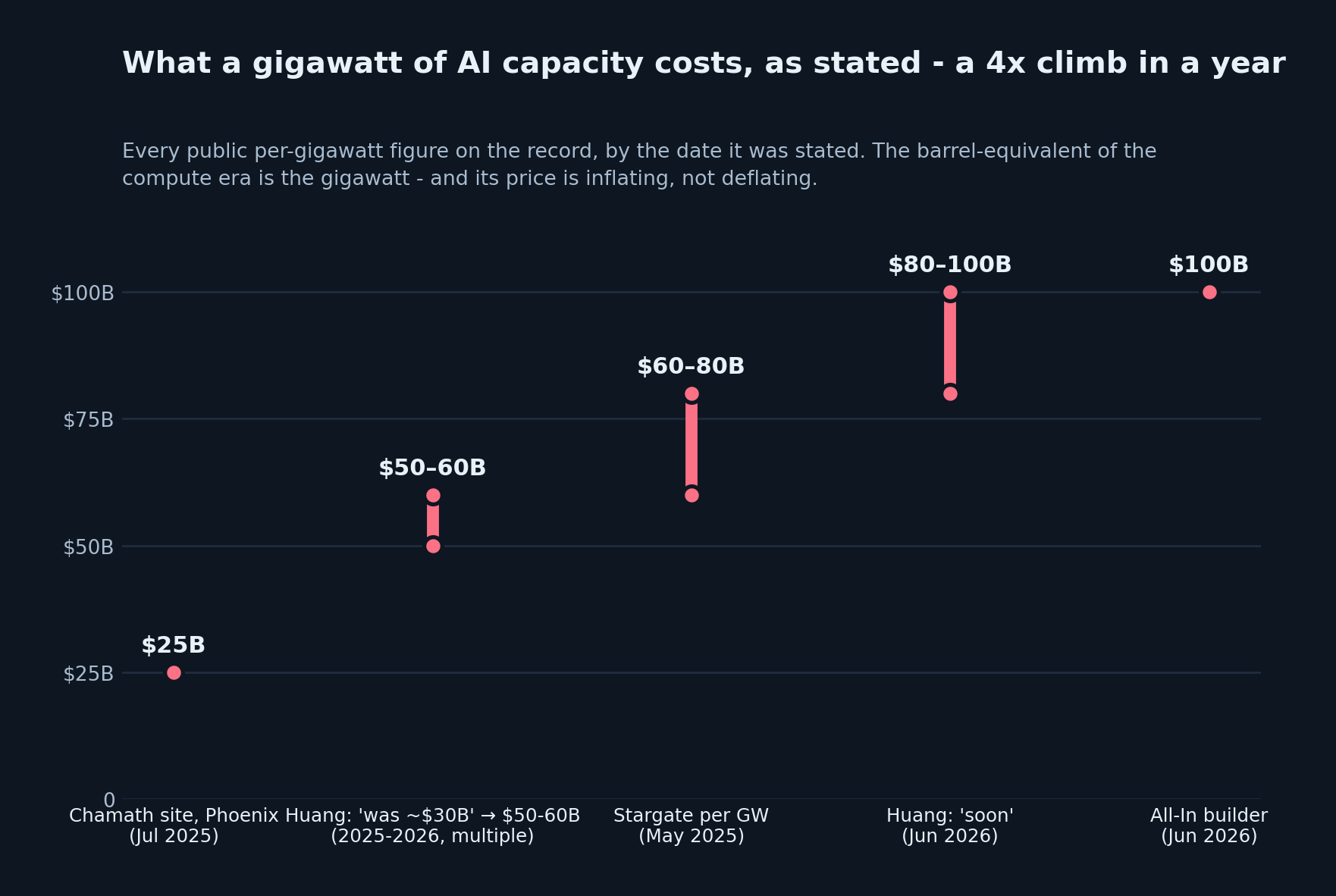
Then there is the barrel-equivalent. The petrodollar era priced crude per barrel; the compute era prices capacity per gigawatt — and every stated figure has climbed. A Phoenix site penciled at $25B per gigawatt in July 2025; Huang's own progression from roughly $30B to $50–60B across 2025–2026, with $80–100B coming soon (June 1); the Stargate build at $60–80B (May 2025); an All-In builder at $100B (June 2026). Fink sized the pipe on the same arithmetic: 70-plus gigawatts needed in the US alone.
But a commodity system needs more than a price — it needs interchangeable units, and here the record carries a genuine three-way collision. Huang asserts fungibility from the podium. Brandon McBee — CoreWeave co-founder, and a commodity trader for a decade before that — flatly denies it (June 10): "it all comes back to fungibility. If you think about gold — gold is defined by its chemical composition… GPU compute today is not fungible… an H100 deployed in one cloud doesn't have the same performance as an H100 deployed in another cloud… in order for something to be commoditized, it has to be fungible." His concession is a timeline, not a surrender: general commodity theory "suggests that it should become that at some point," but not until the machines get easier to operate. And Li is building the resolution: her team published a paper proving "38% performance variance for the same chip," decomposed it into chip, intra-provider and inter-provider components — and then normalized it away across a million daily price points from some 200 sources, the way WTI and Brent benchmarks once manufactured fungibility for chemically heterogeneous crude. Every commodity has basis risk, she noted; you trade it anyway.
Fungibility, it turns out, is not a property of chips. It is a thing benchmarks build.
Leg three, inverted: oil funded the Treasury market — compute borrows from it
The petrodollar's genius was circular: the world paid dollars for oil, and the producers' surpluses came home as Treasury purchases. The input funded the sovereign. Compute runs the circuit backwards. Darius Dale has spent the summer building that case from the bond side: Treasuries are now the world's core risk asset, deficit-driven supply accelerating while the three largest creditor blocs pull back (June 26); term premium is compressed at ~65bps against a ~200bps norm, implying 10-year fair value near 5.6% (July 13); capex bubbles always overbuild and flip firms from asset-light to asset-heavy (June 25); and the AI-capex demand shock is itself an inflation input (July 6). A guest on the Pompliano show reduced it to an identity (July 30): an AI-capex bubble and a sovereign-deficit bubble, both demanding capital, against trailing ten-year savings growth of roughly 55% versus a ~90% long-run mean.
The flow-of-funds evidence agrees. Michael Howell (April 8) traced how AI capex flipped big tech from cash-rich to borrowers issuing huge long-dated investment-grade paper — out to 100-year terms — pulling money out of financial markets; by July 27 he noted buyback growth slowing as cash diverts to capex, so the buildout now competes with the equity bid too. Eurodollar University counted roughly $270B of hyperscaler debt issuance in 2026, near double all of 2025, and named the crowded-out: mortgages, industrials, private credit (July 23). An Odd Lots guest put the same inversion inside the r-star equation (May 29): the neutral rate has drifted from ~0.5% to ~1% or higher, driven by inflation risk, ~7% fiscal deficits — and AI capital demand. Brent Johnson did the arithmetic bluntly in September 2025: NVIDIA's projected spend alone approached a quarter of M2. Even Baker, the most rigorous bull on the record, concedes the strain before answering it: real yields, spreads and CDS widening are the one real negative — his answer being that if compute reprices upward, roughly $2T of hyperscaler operating cash flow funds the buildout and removes some $700B of credit demand (August 4). The rebuttal concedes its own premise: today, compute is a taker of savings, not a supplier.
And yet the recycling is already happening — just not through Treasuries. Gulf sovereign wealth is now the number-one destination for private-market fundraising (a Dwarkesh guest, September 2024): petrodollar pools have become the dominant global capital source, and they are buying compute equity. On BG2 (May 2025) the UAE–US campus was described plainly: "5 gigs, every gig is about 500,000 GPUs." Doomberg marked the dependency's dark side in March: lose Gulf-state financing for the data-center boom — sovereign funds preoccupied and bitter over the war — and the ripple likely tips the US into recession. Oil history's obsolescing bargain — Raymond Vernon's old observation that once capital is sunk in the ground, the sovereign renegotiates — now runs through every Gulf data-center deal.
The petrodollar is not being replaced by the compute dollar so much as it is funding it. The succession, so far, is a wire transfer.
The fix under construction: Fink's mortgage moment
Which is what August 11 was actually about. The operative sentence is Huang's own: the six partnerships "are going to pull together independent long-term capital to fund and support AI infrastructure buildout" — over $500 billion of third-party capital, per the announcement's terms. And the mechanism, from the same stage: "you can think about it as a revenue stream and you can securitize it or effectively divide that risk and sell it to investors who want to participate anywhere in that stack." Fink likened data-center finance today to mortgage-backed securities in the 1970s — the next future of financial engineering — with capital rotating out of $9T of money-market funds — a figure David Solomon put on the table first — into a long-dated, high-credit-quality asset class. Visser's read of the announcement, August 16, needed one sentence: "They don't want to use their balance sheet anymore." He added the adjacent figure — Morgan Stanley to facilitate $1.5 trillion in infrastructure initiative — and a regulatory tailwind: the government, he said, is exempting data-center bonds from key securitization rules to ease asset-backed sales, on explicitly keep-ahead-of-China grounds. That last item is his account of a news report, not yet independently verified here; if it holds, it is the state midwifing the recycling leg into existence.
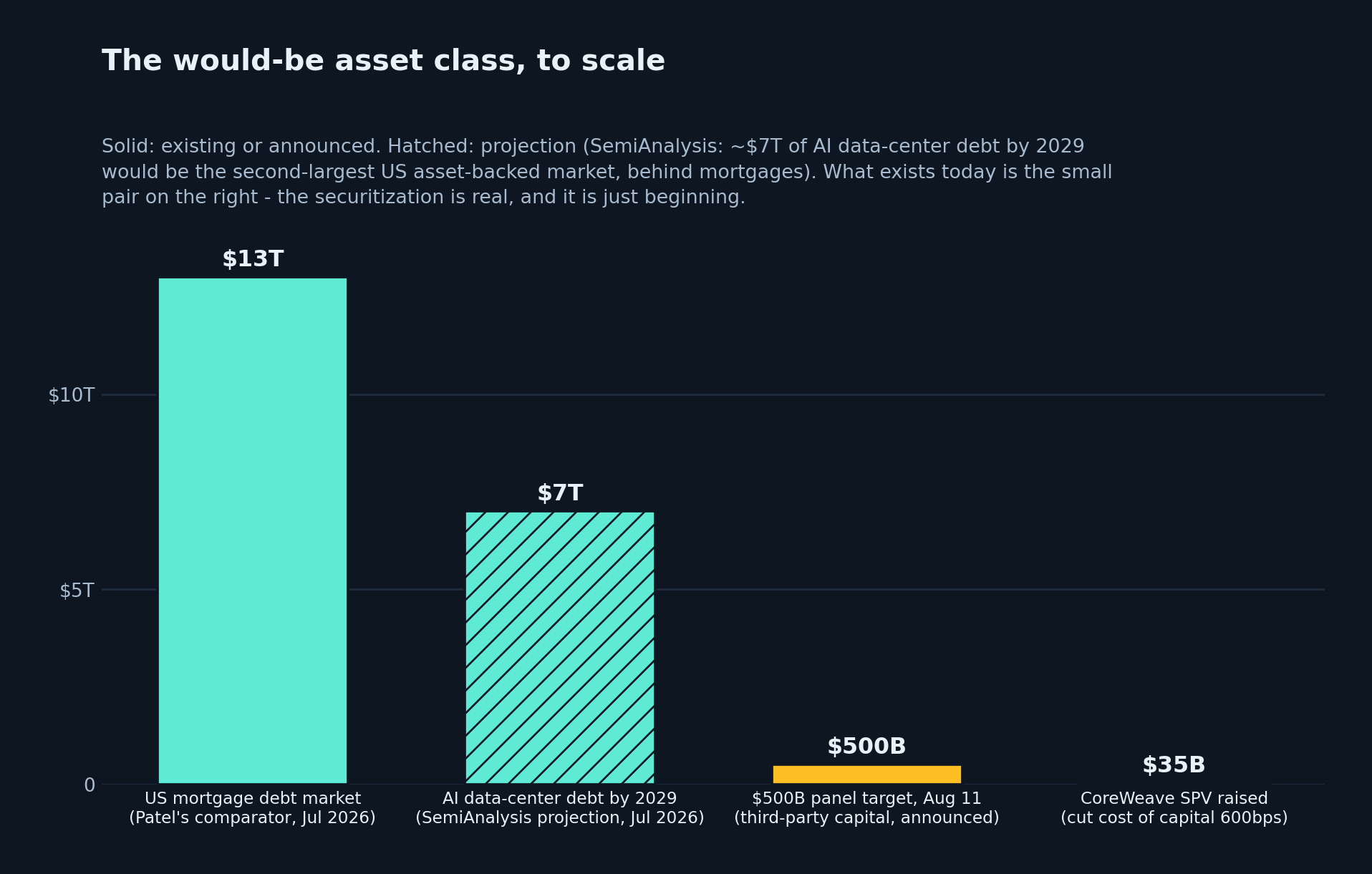
The scale has been quantified — before Fink made the analogy. SemiAnalysis projected in July that AI and data-center capex reaches roughly $11T cumulatively over 2024–2029, with ~$7T of it debt-financed: the second-largest US asset-backed market, behind the $13T mortgage market itself. Against that projection, what exists today is small and real: $500B announced on a stage, and roughly $35B raised through CoreWeave's SPV structures — financings that cut its cost of capital by 600 basis points.
The plumbing is further along than the announcement suggested, because CoreWeave built a working prototype first. McBee, June 10: the contracts are take-or-pay, and the labs' own lawyers hardened them — "You can't upgrade or change the infrastructure within it. You cannot cancel the contract. We want it for 5 years." The financing wraps those cash flows in project-finance clothing: "we could take these financings and put them into [SPVs] or we'll just call it a box… pair this five-year take-or-pay contract to an amortization schedule on the debt… revenue comes into the box, pays down the amortization schedule, pays down the operating costs of the data center, and it still has a 25% contribution margin of profit up to the parent co." And the paper has already crossed the investment-grade line: "one of the latest ones we did… investment-grade rated, first of its class. No one had done this before for GPU financing — non-recourse HPC infrastructure financing — and got done at SOFR plus 225… we were able to bring in the insurance tranche of capital, which is a massive tranche of capital out there." Over $21 billion raised year-to-date, by his count — and, as he put it, "people weren't making loans into the hyperscalers to go credit these buildouts… It's on CoreWeave honestly to be building this path." Ten months before Fink's stage, the first mortgage had been written.
Note what the collateral actually is. Brian Venturo, then CoreWeave's CTO, said it in June 2024: GPU-backed credit facilities are not really backed by GPUs; they are closer to trade-receivables financing against contracts with investment-grade counterparties. A No Priors guest repeated it this February: the primary collateral is contracted take-or-pay cash flow, not the depreciating silicon, with debt fully amortizing over four to five years against a two-to-three-year capex payback — the media, he said, got this backwards. That makes the new paper offtake paper — closer in spirit to the Treasury bill the petrodollar bought than to a pawn ticket on hardware. The credit anchor beneath it all is a single company: as Dunning put it from the buyer's seat, "the only rock is Nvidia… extremely well-capitalized entity who is not going anywhere" — the vendor whose backstop, SemiAnalysis argues, is a temporary crutch until banks lend to neoclouds standalone, the way they lend to airlines and fabs.
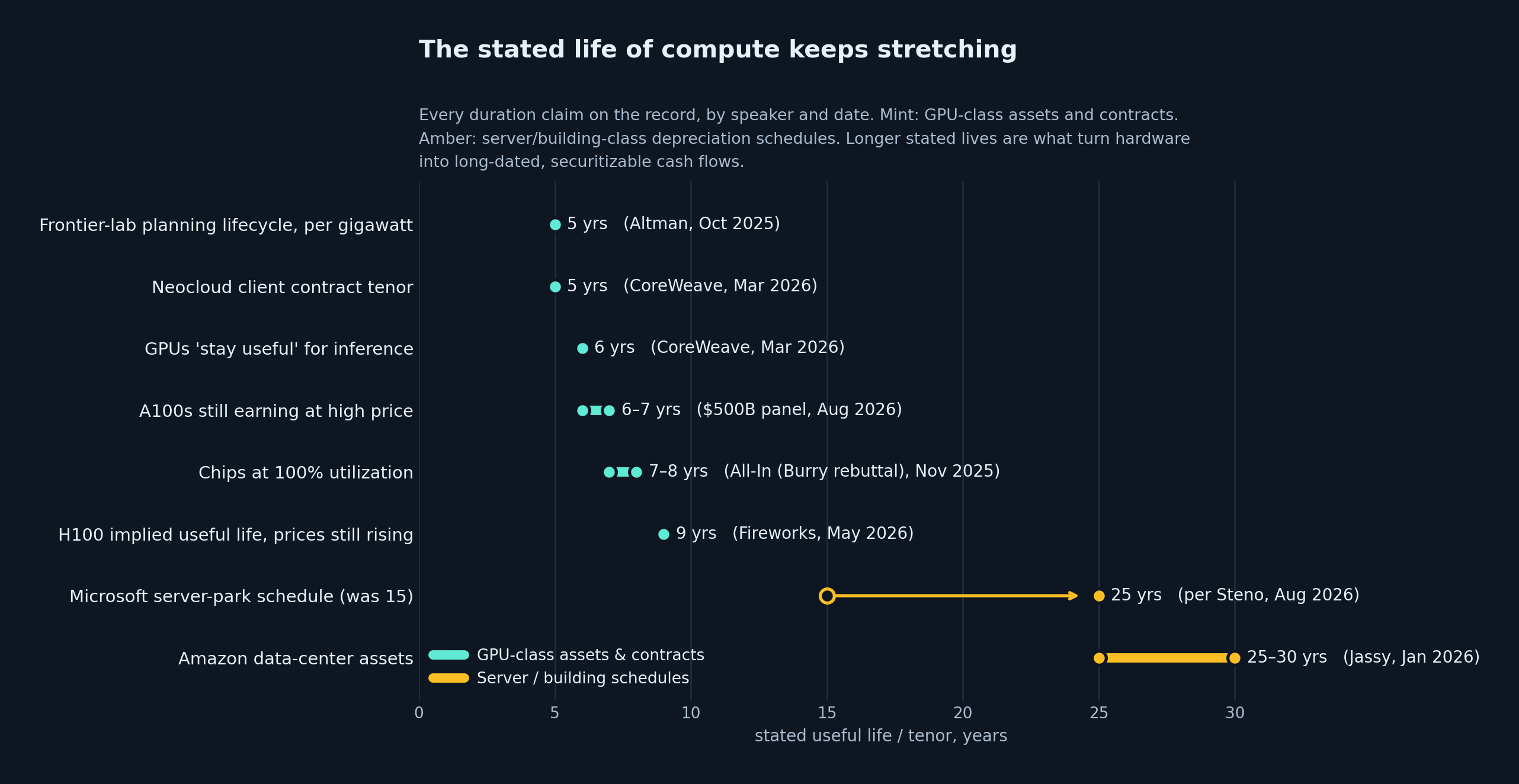
The collateral has clocks, and they disagree violently. Andy Jassy books Amazon's data-center assets at 25–30 years (January). Lisa Su's generational arithmetic says each new part delivers up to 18x more tokens per dollar (July 23) — which should collapse the old part's price. Yet a No Priors guest from the inference cloud Fireworks, running clusters at mid-90s utilization, reports 4.5-year-old H100 prices still rising toward a ~9-year implied life (May 1). Three companies, one impossible triangle — and the accounting has become the battleground: Steno flagged in August that Microsoft stretched server-park schedules from 15 to 25 years, shifting capex toward financial leases, while Alphabet shortened its depreciation and was punished for the honesty. Meanwhile the state subsidizes the base: Brad Gerstner noted (August 8) that accelerated depreciation at a 26% corporate rate hands back 26 cents on every capex dollar this year. Longer stated lives are what turn hardware into long-dated, securitizable cash flow; every incentive now points toward stating them longer.
The same history that supplies Fink's analogy supplies its warning label. Mike Green (July 24): the data-center buildout is loading investment-grade credit with leverage underwritten against equity values, not cash flows — his phrase for it is a replay of 2006 housing, where the loan was backed by the home price, not the borrower. Niall Ferguson's 2008 autopsy of securitization — perverse origination incentives, risk pushed to those least able to understand it — annotates the MBS blueprint from inside the analogy itself. Eurodollar University sees the duration mismatch (capex today, uncertain returns for years, ~$270B of paper the market cannot absorb at yesterday's prices — July 21) and a collateral rot already underway elsewhere: software loans, it argued in May, are becoming the subprime of the 2020s. Visser himself flagged Meta's auditor raising rare red flags on off-balance-sheet SPV data-center accounting in March. And the deepest crack runs through one voice: Sam Altman has said both that compute is so valuable a heavy buyer is safe because it can always be resold (July 28) — the liquidity assumption on which repossessed collateral has value — and, nine months earlier, that a glut will come for sure, in two to three years or five to six, and the people who signed existing infrastructure contracts will get badly burned (October 2025). Both statements cannot govern the same securitization. One of them will be tested by 2029.
Leg five: from no futures market to the CFTC's desk in 22 months
In August 2024, a No Priors guest described AI cloud as not really cloud at all — colocation with forced multi-year fixed reservations, paid up front, with no elasticity and no options or futures market to hedge; building those instruments, he noted, was a large opportunity. Twenty-two months later the instruments have names. This June, in the space of ten days, the market's construction crew appeared on one program in sequence — the template, the buyer, the merchant, the exchange.
The template: Lewis Hart, who runs corporate advisory and banking at Brown Brothers Harriman, laid out commodity finance — the "biggest $20 trillion market that no one talks about," with commodity lending proper "about 4 or $5 trillion" — borrowing-base lending, self-liquidating credit, advance rates ("if you pledge me a pound of copper, I'll lend you $0.75, $0.80 maybe more"), hedged clients "long physical… short paper." Asked whether compute qualifies, he applied his two criteria — homogeneity and volatility — and answered as a banker, not an enthusiast: "memory chips and compute are extremely volatile right now. We've been thinking a lot about whether that's a good candidate for a futures contract," and then: "I actually think it's a great candidate for the futures market… I know some of the exchanges are spending a lot of time on this."
The buyer: Dunning, four days later, described compute deals that already trade like pre-futures physical commodities — "This is not spot compute. This is like 8,000 GPUs for three years, four years, five years… Do you pay half upfront?… Credit risk on both sides" — and revealed that the derivative stack has begun assembling itself inside the bilateral market: "we're looking at their CDS on some of these [neoclouds] and thinking… maybe we should pay you $3.50 an hour and take out CDS for $0.10 for our equivalent of insurance." His hedging demand is explicit — lock in future delivery, hedge the risk of waiting — and so is his resistance: "defining what compute is is pretty hard, and I have no idea what physical delivery would be… they're all idiosyncratic… I need thousands of GPUs or bust. That's my lot size."
The merchant: McBee, whose take-or-pay boxes are the cash-flow factories the futures would hedge. And the exchange: Li, whose answer to Dunning's delivery problem is the oil market's own — don't deliver, settle. "We will be launching GPU futures and options at CME in a couple of months pending CFTC approval," she said on June 15; the contracts will be "financially settled, just like the traditional oil settlement," accessible through any commodities broker. Her hedger map transposes the crude complex one-for-one: "the neocloud would be the Shell in this example" — naturally long, shorting futures to stabilize revenue — while the natural shorts are, in her words, "everybody in this room." She wants bank trading desks on compute, and reports the conversation has been running with various banks for a long time. The US derivatives regulator, per a guest on the Pompliano show (March 25), already calls compute an emerging asset class it finds exciting. Prediction markets got there first — Polymarket ran GPU-price contracts settled in February and April — because, as an Odd Lots guest observed in June, their speed lets them financialize commodity-like exposures a year before an exchange can list one.
The second venue is no longer a rumor. Kush Bavaria, the MIT-trained co-founder of Ornn, spent mid-August on two stages describing the same market from the builder's seat — opening, on Moonshots, with corroboration from the top: "Larry Fink just said it today that we need exactly this futures market for compute." His hedger map is Li's, drawn from the older commodity: "the farmers in today's world are the data centers themselves" — "the chips are the corn, and we let data centers pre-sell in a futures market" their capacity, with the model companies on the other side, the corn-and-cereal circuit transposed. Where Li's CME contracts settle financially against her indices, Ornn is building "compute as an asset class infrastructure that allows people to hedge, finance, and trade compute": its own index family — "these indices are then tradable on some of the CFTC-regulated markets" — structured trades on top, and an exchange as the stated goal. And his answer to the fungibility problem is the oldest one in commodities: grades. Venezuelan crude is sludge, Iranian crude runs cleaner, and everything prices off the benchmark anyway; compute, he argues, lands the same way — neocloud pricing data aggregated anonymously by chip type, specified into "different classifications, different grades," until "there will be a benchmark compute and the rest trade off of that price." Basis trading is how oil absorbed heterogeneity; it is how the 38% same-chip variance Li measured would be absorbed too.
The demand he reports for the paper is the recycling leg asking to exist. On his numbers, "maybe we've accounted for 300 billion out of two trillion" of buildout funding — and in Riyadh, "the money wants to come in, but it wants to be liquid," hedged across many data centers rather than sunk into one: Gulf surpluses asking for exactly the diversified, tradable claim on compute that Treasuries once were on the American sovereign. Asked what fraction of data-center funding could eventually flow through such a market: "the goal is 90%." One more echo belongs on the record: before a New York meeting, Bavaria found himself with Lewis Ranieri — in his words, "the guy who invented the mortgage-backed security." Fink reached for the MBS analogy from a stage; the futures builder is taking meetings with its inventor. Two venues — one from the index side, one from the exchange side — are now racing to make the same market, and in oil's history the moment exchanges begin fighting over the benchmark is the moment the commodity has arrived.
Set the timeline against oil's. Crude traded physically for a century; WTI futures listed in 1983, decades after the majors built the trade. Compute went from "no futures market exists" to CFTC-pending exchange contracts, an index family on the Bloomberg Terminal, buyer-side CDS synthesis and investment-grade non-recourse paper in under two years — with a second venue building in the open. Whatever this is, it is not slow.
Leg four: embargoes, straits, and customs ledgers
The chokepoint leg needs the least argument because it has the longest paper trail. Niall Ferguson said it in November 2019 — the tech war matters more than the trade war, because China cannot make the most sophisticated semiconductors itself — and by December 2025 had sharpened it into the embargo frame: US counter-leverage is its chokehold on the top-end chips, designed by NVIDIA, manufactured by TSMC in Taiwan. His strait to go with the embargo: Taiwan produces all the AI GPUs, a blockade is the defining tail risk of the term, and the chokepoint appreciates as TSMC's centrality rises (January 19); the Cuban Missile Crisis of Cold War II, he expects, will be a Taiwan semiconductor crisis (May 2022, restated since). Bessent's 97% is the official-sector echo. What is new in the compute era is that the chokepoints run both ways: Ferguson himself noted in October 2025 that China's rare-earth export curbs broke a US trade embargo and forced a climbdown — the West chokes chips, China chokes the elements chips are made with. The petrodollar's embargoes ran one direction; this is a mutual standoff. Jacob Shapiro's counterweight: the same Taiwanese fabs both powers depend on are a mutual deterrent — a silicon shield — and the supply chain fragments into regional strongholds rather than snapping (2022).
The commodity's trade flows are now visible in customs data, as oil's were in cargo manifests. Steno, August 11: South Korean semiconductor exports are running +160% year over year while forward pricing implies the export trade flatlines to zero growth — in his words, the one scenario that won't happen. And the old system's instruments are being written into the new one: the state is placing price floors and take-or-pay offtakes under chokepoint metals (the Defense Department's rare-earth deal, July 2025, described on multiple shows as the blueprint), Steno argues export curbs have made the frontier labs too big to fail — a government put under the downside (June 16) — and Howell, in his July incarnation, expects governments to finance endless AI infrastructure because ceding the race means ceding control of the world. Even the cartel vocabulary has arrived, though note its actual shape in the transcript: Visser's August 16 line — "they may become the Saudi Arabia OPEC of compute" — is a bearish read on Alphabet, a company losing the model-prestige race and retreating to infrastructure rent. The cartel vocabulary has migrated before any cartel exists — and the crown it describes is a consolation prize.
The counter-case is loud and comes from the arms dealer himself: Huang has called export controls a fallacy that failed — NVIDIA's China share fell from 95% to 50% while Chinese AI advanced into the vacuum (May 2025, repeated since). Dylan Patel's ledger splits the difference: chip controls work, equipment controls failed (China was recently ~48% of ASML's revenue), and the further controls push China from the cutting edge, the higher the risk over Taiwan. Gerstner made the pro-controls empirical read in February 2025: the leading Chinese lab's compute gap is the smallest it will ever be, and without top-end access the next step gets very hard. Embargoes seeded OPEC's power once, too. The analogy cuts both ways.
The layer beneath: the old commodity fuels — and funds — the new one
Oil was both the input and the commodity. In the compute system those roles split: energy is the input, compute the product — which chains the new system to the old one at the meter, at the strait, and through the capital account. Doomberg's operating model is the cleanest statement: gas in, data out — self-contained off-grid pods sited at the wellhead, because data-center demand is incompatible with existing grids. The vendor agrees from the other end: Huang has argued nations with excess energy should export refined energy — AI — rather than raw energy (May 2025); on BG2 the Middle East's plan was described as converting cheap power into tokens and exporting them as it once exported oil; an All-In guest said the same in November. The refinery metaphor is exact: crude in, product out, margin captured at the conversion step. Satya Nadella supplied the new system's unit of account with a watt in the denominator — tokens per dollar per watt, the metric he expects GDP growth to correlate with (January 20).
The chain binds hard. Gromen's clock mismatch is the sharpest form of the depreciation objection: chips carry a three-to-four-year useful life while electricity hookups stretch to 2030 — the market will eventually reprice chips it cannot power, and he reports NVIDIA and AMD silicon already sitting uninstalled outside data centers short of copper, transformers and turbines (November 2025, April). The old geography persists underneath: a Geopolitical Cousins episode traced Hormuz LNG disruption through Taiwan's power grid — 40% of the island's electricity — to halted fabs and a starved buildout. The old commodity's chokepoint sits upstream of the new one's. And the price relationship has begun to invert: Doomberg notes that as AI bids up natural gas, shale oil becomes a byproduct given away — his equilibrium oil price is $55. Meanwhile Bitcoin miners are arbitraging the two digital energy commodities in real time, earning more dollars per kilowatt-hour on AI compute than on Bitcoin (July). Whether this system ends up a compute dollar or, more honestly, a watt dollar is a fair question — Lyn Alden's version is that energy is the biggest moat in data centers — but either way, the succession inherits oil's map rather than escaping it.
The objection oil never faced: a numeraire that will not hold still
Now the hard part, which no source confronts squarely. A barrel of Brent in 1974 and a barrel in 2004 contained the same joules; OPEC could set its price because the unit held still. The compute era's unit does not. By the principals' own stated numbers, the price of a fixed level of capability collapses at rates oil never saw in its worst glut: Altman put the decline at roughly 40x per year in October 2025 and roughly 10x per year this August; Nadella says token prices halve every three months — about 16x a year — and calls tokens an ever-cheaper commodity (January); Patel's estimate runs 60–100x a year. They disagree only about how fast the floor falls.
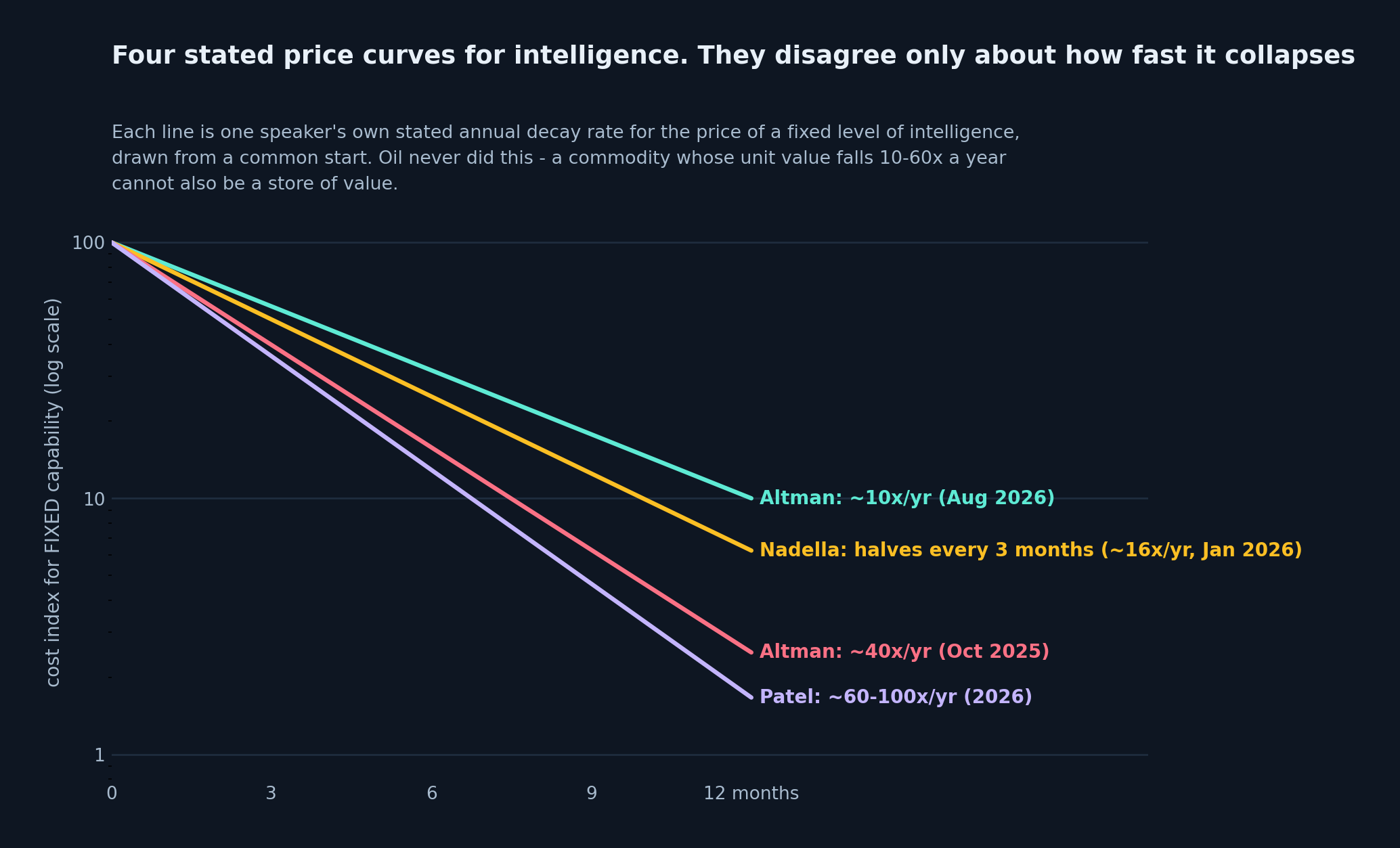
A commodity whose unit value falls 10–100x a year cannot be a store of value, and stores of value are what reserve systems hold. Worse, the market currently cannot agree on which unit is the commodity at all. The GPU-hour is rising — Baker's renewals, Li's indices, the contango curve, 4.5-year-old H100s appreciating. The token is collapsing — Nadella's halvings; Visser himself called the token price index peaked, best case sideways, even as compute demand explodes (June 28). And the compute budget is inflating: Sundar Pichai reported in May that compute costs are rising — memory especially — so a fixed budget buys less compute than planned, while revenue sits compute-constrained. Output deflating, input inflating, in the same quarter, from the two biggest buyers on earth. The buyer-side revolt is already on the record: Chamath Palihapitiya says his firm's token costs are doubling every 45 days against a downstream productivity gain of five percent at best (July 11).
The revenue gap lives inside the same question. Cory Doctorow, on We Study Billionaires (July 29): roughly $1T-plus spent to date — Gartner projects $2.5T by year-end — against about $50B of annual revenue, on hardware replaced every two to five years. Visser's answer, given five days before his Gave reading, reframes rather than rebuts: the revenue is denominated in human time — "That's human time… We're now doing what used to take 10 years in 3 months" — while the underlying quantity compounds at machine speed. Both are measurements of the same deflating unit, taken from opposite sides. Neither closes it.
Two reconciliations exist on the record, both from the men selling the machines. Huang's: extreme co-design drives tokens per second per watt up orders of magnitude yearly, cutting token cost roughly 10x a year even as compute price rises — the refinery gets better, so crude gets dearer while gasoline gets cheaper. Nadella's: make the unit of account the conversion ratio itself, tokens per dollar per watt. Both amount to the same move — the commodity is the capacity, not the output. Oil's own history offers the frame's last comfort and last warning at once: as Daniel Yergin's chronicle of the industry documents across a century, every high price cures itself by financing the glut that breaks it. Compute's cure is faster, because it is built into the product. Whether a monetary leg can stand on a commodity that improves like that is the question this piece cannot close.
The rivals — and the synthesis already speaking itself
The petrodollar's seat has other claimants, and the strongest already does what compute cannot yet do.
Dollar stablecoins collateralized by T-bills create structural Treasury demand that mimics the petrodollar system — and stablecoin market cap and Bitcoin have moved together for a decade.
Luke Gromen · October 2025 · the recycling leg, already running under the Genius Act; the Miran white paper he cites (November 2025) frames a global stablecoin glut up to $3T as engineered T-bill demand — a Bernanke savings glut, by design
Gromen's hedge: stablecoins shift T-bill demand pocket-to-pocket, not net-new (June 1). Hayes's arithmetic: when marketable debt grows faster than the economy, stablecoin demand can't save it (October 2025). And the ceiling: a projected $6.6T of inflows against only $6.5T of T-bills in existence to collateralize them.
Gromen · Arthur Hayes · a Real Vision guest (September 2025) · the leg is real and capped — its maximal bull rules out his own fix at the flow level
Global Treasury reserves are never rising again after weaponized sanctions; central banks buy gold instead — gold overtook Treasuries in reserves last year and probably overtakes the dollar itself by 2028–2029.
Luke Gromen · November 2025, July 10 · fresh August prints from Visser's own reading: China added 20 tons of gold in July, its largest monthly purchase since October 2023, and the Bank of Korea resumed gold buying after 13 years
No single currency can replace the dollar at the system's center — only very gradual diversification; the dollar stays central but fragmenting.
Mohamed El-Erian · February 19 · the base case every successor story must beat; note the same Treasury outflow reads three ways — regime change (Gromen), dollar-shortage mobilization (Eurodollar University, June 15), weaponization capping official demand (Alden, April)
Held side by side — a collision none of these voices staged — the rivals stop competing and start specializing. Compute is the commodity leg: universal, dollar-priced, chokepointed, being financialized at speed. Stablecoins are the recycling leg: a structural T-bill bid, already flowing, with a hard ceiling and its own skeptics. Gold, with Bitcoin contesting, is where the reserve function has actually gone. The petrodollar bundled all three functions into one barrel; its succession, on this evidence, is tripartite. And the synthesis is no longer only ours to propose: Gave's note packaged it, and Visser reached it independently on August 16, in one sentence: "next year, starting in September, the next constraint is not physical, it's financial — the guardrails, consumer agents, the settlement, it's stablecoins, the tokenization." The instruments splicing the legs together already exist at the edges: an Empire guest described debt-not-equity DePIN financing channeling the $300B-plus stablecoin float's yield demand directly into GPU and infrastructure debt — $150M caps filling in 45 minutes — and is sure the labs are already looking at tokenizing compute or token streams to raise money for the next run (January 30, June 19). The rival leg is starting to fund the compute leg. That is not a fight for the throne; that is an anatomy assembling itself.
What would confirm it — what would kill it
Confirming markers — each dated, each checkable:
- GPU futures trade on CME. Li's contracts were announced in June as pending CFTC approval, financially settled like oil. Listing, open interest, and the first bank compute desks are the cleanest possible markers that leg five closed. A second venue's contract design reaching the public record would confirm the market, not just the vendor.
- Benchmark securitized issuance out of the August 11 platforms. First deals within two to three quarters; a functioning secondary market; the data-center securitization carve-out Visser reported confirmed in the rule book. McBee's SOFR+225 investment-grade print is the baseline — watch whether spreads tighten toward infrastructure paper or widen toward Green's 2006 replay.
- Rental prices hold through the 2027 capacity wave. Baker's renewal print (mid-$2 to just under $4 per GPU-hour) and Li's indices are the public price record. Holding through the announced gigawatts confirms demand depth; the alternative is marker one of the kill list.
- The state completes the doctrine. Sovereign compute funds; export-control escalation; offtake floors extended from chokepoint metals to compute inputs; Bessent's production-share statistics moving toward his 70–80% target. Rosenvold's blunt version — inflating and growing out of $38T of debt via an AI-powered bull market is definitely the plan — becoming explicit policy.
Kill signals:
- Howell's fiber repricing. An 80–90% collapse in rental rates — the Global Crossing path he named on July 30 — ends the fungible-commodity claim on contact. Ferguson's own falsifier is the equity-market form: an 1893-style panic moment if returns on the capex boom disappoint.
- A credit event before the recycling leg exists. Eurodollar University's duration mismatch (~$270B of 2026 paper the market can't absorb at yesterday's prices) extending into failed issuance; Meta-style SPV auditor flags spreading; evidence accumulating for underwriting against equity values rather than cash flows.
- The collateral clock breaks the wrong way. Patel's own marker: a clean pricing divergence between adjacent GPU generations. If 4.5-year-old hardware stops appreciating and Altman's glut arrives while contracts still have years to run, take-or-pay paper meets its first real test — and Gromen's chips-versus-hookups clock mismatch starts marking to market.
- The rivals take the legs. Stablecoin float compounding its T-bill bid while compute issuance stalls — the recycling function settling permanently outside compute. Gold's reserve share continuing toward Gromen's 2028–2029 crossover with no reserve-manager uptake of compute-linked assets.
- The numeraire wins. If contracted GPU-hour prices start following token prices down — if the deflation of the output finally reaches the capacity — the store-of-value leg is dead, and the compute dollar joins the list of commodities that financed their own glut. High prices cure themselves; this commodity's cure ships quarterly.
The barrel held still; a monetary order stood on it for half a century. Compute is real, its pricing is real, its chokepoints are real, and its plumbing is being welded in public view. What it lacks, the frame makes precise: the circuit that turned a commodity into a system — surpluses coming home — and a unit steady enough to anchor one. A frame this young is not to be believed; it is to be watched. The futures listing, the first benchmark issuance, the 2027 rental prints, the price gap between chip generations — watch them, and the frame grades itself. For now, the compute dollar remains a system under construction, financed by the one it means to succeed.
Sources
Quotes are verbatim spans from show transcripts; all other claims are paraphrased from the named speaker's remarks on the dates shown, from the Synthos knowledge base. Primary voices: Louis Gave (via Jordi Visser's August 16 reading of the Gavekal note); Jordi Visser (August 15, 16); the August 11 financing panel — Jensen Huang, Larry Fink, David Solomon, Bruce Flatt, James Zelter, with KKR's digital-infrastructure head; the Odd Lots commodity-finance sequence — Lewis Hart (June 1), Iain Dunning (June 5), Brandon McBee (June 10), Carmen Li (June 15), and Brian Venturo (June 2024); Gavin Baker (August 4); Darius Dale (June 25–26, July 6, 13); Michael Howell (April 8, July 24, 27, 30); Eurodollar University (May 28, July 21–30); Luke Gromen (May 2021; October–November 2025; February 10, March 5, April 23, June 1, July 10); Niall Ferguson (November 2019; October–December 2025; January 19, May 22); Andreas Steno / Steno Signals (June 2024; June 16, August 3, 11); Scott Bessent (January 20, February 20, April 14); Lyn Alden (2021–2022 petrodollar series; April, July); Doomberg (2022–2026 energy series; March 20); Satya Nadella, Sundar Pichai, Andy Jassy, Lisa Su, Sam Altman, Brad Gerstner, Chamath Palihapitiya, Dylan Patel / SemiAnalysis (dates in text); Mike Green (July 8, 24); Brent Johnson (September 2025, March); Arthur Hayes (October 2025); Mohamed El-Erian (February 19); Jacob Shapiro (2022–2023); Raoul Pal (July 2024); Kush Bavaria (Ornn) on Moonshots and NYSE Wired (August); guests via All-In, No Priors, Forward Guidance, Empire, Real Vision, Compound & Friends, BG2, Dwarkesh, Geopolitical Cousins and the Pompliano show, attributed by role where the transcript names them only by channel. Dates without a year are 2026. Chart datapoints are the speakers' own stated figures, attributed on each chart and restated in the text. For how the knowledge base is built and how voices are weighted, see our methodology and verified voices.
Go deeper: the AI build-out Think Piece · the macro regime · Predictions · the Frontier Gap Board.